
Hiring problems in 2026: what HR and recruiters really ran into
Published
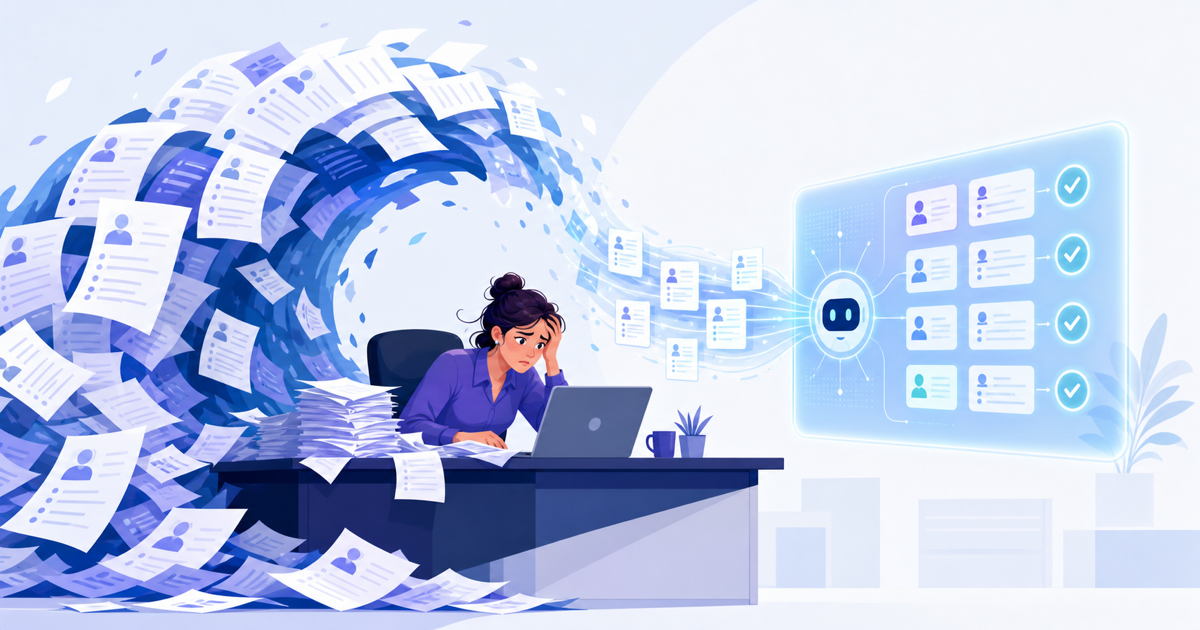
The main HR problems in 2026 are not a “talent shortage”, as they were until recently, but overload: there are too many applications and no time or people to process them. Recruiters drown in a stream of resumes, the hiring cycle stretches into weeks, and candidates increasingly embellish their experience — sometimes with the help of the very same neural networks. Below we break down five key hiring problems and show how they are solved by teams that have already rebuilt the process.
What changed in hiring by 2026
A couple of years ago the fight was for every candidate. Now the pendulum has swung the other way: a single vacancy gets a stream of applications, and the bottleneck is no longer attraction but selection. Processing everyone by hand is physically impossible, so some strong candidates simply get lost in the crowd.
Remote and hybrid work played their part: geography no longer limits the funnel, and a single vacancy gets applications from all over the country and abroad. At the same time, applying has become dead simple — services and neural networks prepare a resume and cover letter in a minute. The barrier to entry dropped, and with it the number of irrelevant applications rose.
Candidates themselves changed too. Resumes and cover letters are increasingly written by AI, test tasks are solved with hints, and in video interviews a person can quietly peek at prompts on a second screen. As a result, classic selection tools stopped giving an honest picture — and that is the root of most HR problems in 2026.
Problem 1. An avalanche of applications: 400+ per vacancy
The first and most visible pain is volume. An active vacancy today easily gets 400+ applications. Even if a recruiter spends one minute per resume, that is almost seven hours of pure time just for the initial review — and there is more than one vacancy in progress at the same time.
- strong candidates get no reply for weeks and leave for whoever is faster;
- selection goes by formal signs (keywords in the resume) rather than real skills;
- the recruiter burns out from monotonous manual work;
- the hiring manager gets the wrong people and loses trust in HR.
The problem is not that there are many applications, but that there is nothing to process them quickly and objectively. The longer the employer stays silent, the higher the chance the best candidate has already accepted someone else's offer — the speed of the first reply directly affects who you end up with.
Problem 2. A stretched hiring cycle: a week or more per candidate
The second problem is speed. A single candidate's journey from first contact to final decision takes a week or more: agree on a time, run a screening, wait for a technical interview with an expert, gather feedback, make a decision. Every stage is messages, reschedules and waiting.
While that week goes by, the market does not stand still. In that time a good specialist gets two or three more offers and accepts the one that replied faster. Slow hiring in 2026 is not just an inconvenience but a direct loss of the best candidates and missed profit for the business.→ Why hiring speed directly affects business metrics
Problem 3. Lies in resumes and a mismatch with real experience
The third pain is trust in what is written in the resume. “Five years with Python”, “led a team”, “built from scratch” — behind the nice wording there is often quite different experience. And if embellishment used to be limited by the candidate's imagination, now they have a helper.
Here is a telling detail: modern systems do not validate a fake or embellished resume at all — on the contrary, an AI will gladly offer to “improve” it even further. In other words, the usual tools not only fail to catch the experience mismatch but actively help create it. A person's real level surfaces only in a live interview — but you still have to get there, spending time on dozens of candidates.
The most expensive scenario is when the mismatch surfaces only after the employee has started: weeks spent on hiring, time on onboarding and budget spent, and the person can't handle the tasks. That is why it pays to check real skills as early as possible, not during the probation period.
Problem 4. Subjectivity and different criteria across interviewers
The fourth problem is assessment “by eye”. Two interviewers often rate the same candidate differently: each has their own set of questions, their own mood and their own idea of a “strong” specialist. As a result, the hiring decision depends on who exactly ran the interview rather than on objective data.
For the business this means unstable hiring quality: today you took on an excellent person, tomorrow “by feel”, and a month later it turns out the skills are not there. Without a single assessment scale, comparing candidates against each other fairly is almost impossible.
Problem 5. Overload on HR and technical experts
The fifth pain ties all the previous ones together. The flow of applications, the long cycle, the manual resume review and subjective interviews all fall on the same people — HR specialists and technical experts. And the business needs the experts first of all for their core work, not to spend hours running identical first-round interviews.
- many applications — the recruiter can't keep up;
- to keep up, experts are pulled into interviews — experts get distracted from the product;
- interviews are subjective and slow — hiring quality drops;
- you have to hire more — the load grows again.
You can't break this circle with manual methods — you need a different approach to first-round selection.
How to solve hiring problems in 2026: from manual selection to automation and AI interviews
The logic of the solution is simple: take the routine off people and hand first-round selection to a system that works fast, honestly and by unified rules. That is exactly what HeadSync was built for — a hiring automation platform: the AI interviewer runs a voice interview right in the browser, with no app installation, and produces a structured report for each candidate.→ HeadSync — a hiring automation platform
How this closes the problems described above: interviews run in parallel and 24/7, so you can talk to every relevant candidate rather than just the first ten. First-round selection happens right away — this saves 1 to 2 weeks on hiring. The system controls integrity: it notices AI use, hints and extra windows on the screen. All candidates go through the same questions and get comparable scores on a single scale, while a live expert only joins in for the finalists.
Speed deserves a separate mention: by automating the first stage, hiring conversion speeds up roughly 7×. Questions adapt to the role, the candidate's level and stack, and at the output the recruiter gets a transcript of the conversation, a skills assessment and a recommendation — that is, a ready basis for a decision rather than a raw recording.
What exactly ends up in the report: a transcript of the candidate's answers, an assessment against key competencies and a final recommendation. The recruiter does not need to rewatch the whole recording — it is enough to open the report and immediately see the strengths and weaknesses. From there it is easy to compare candidates against the same criteria and invite the genuinely best ones to the final round.
An important practical point is rollout. It is minimal: a company just registers in the dashboard, creates an interview for the role and sends the candidate a link. No lengthy integrations and no software to install on the candidate's side.
Frequently asked questions about hiring problems in 2026
- Why are there so many applications per vacancy in 2026?
- The market has shifted: there are more job seekers and more tools for quickly mass-sending resumes. An active vacancy gets 400+ applications, and the main difficulty is not finding people but selecting them quickly and fairly.
- Can a resume written by a neural network be recognised?
- The resume by itself — almost not: systems don't validate it, and AI even helps embellish it. The real level is more reliably checked in an interview, where you can see how the person thinks and answers live.
- How do I speed up hiring without growing the HR team?
- Automate first-round selection. AI interviews run in parallel and around the clock, while live experts only join in for the finalists — this saves 1 to 2 weeks off the hiring cycle.
- Is it hard to roll out AI interviews?
- No. You register the company in the dashboard, build an interview for the role and send the candidate a link — the interview runs in the browser with no app installation. Other questions are covered in the answers section on the site.
- Is an AI interview suitable for technical vacancies?
- Yes. Questions are configured for a specific stack and grade, so the platform helps check both professional competencies and how the candidate reasons through a task.
- Will an AI interview replace a live recruiter?
- No, it removes the routine. The final decision and the work with people stay with HR and the hiring manager — it is just that already vetted and comparable candidates reach that stage.
The gist
HR problems in 2026 come down to one thing: manual hiring can't cope with the new volume and the new reality, where resumes are embellished and there is not enough time for everyone. The avalanche of applications, the long cycle, lies in resumes, subjectivity and expert overload are links in one chain, and they are solved together, through automating first-round selection.
If you recognised your department in these problems — see how it works for you: leave a request, and we'll show the platform on a real vacancy.